
Walkscapes
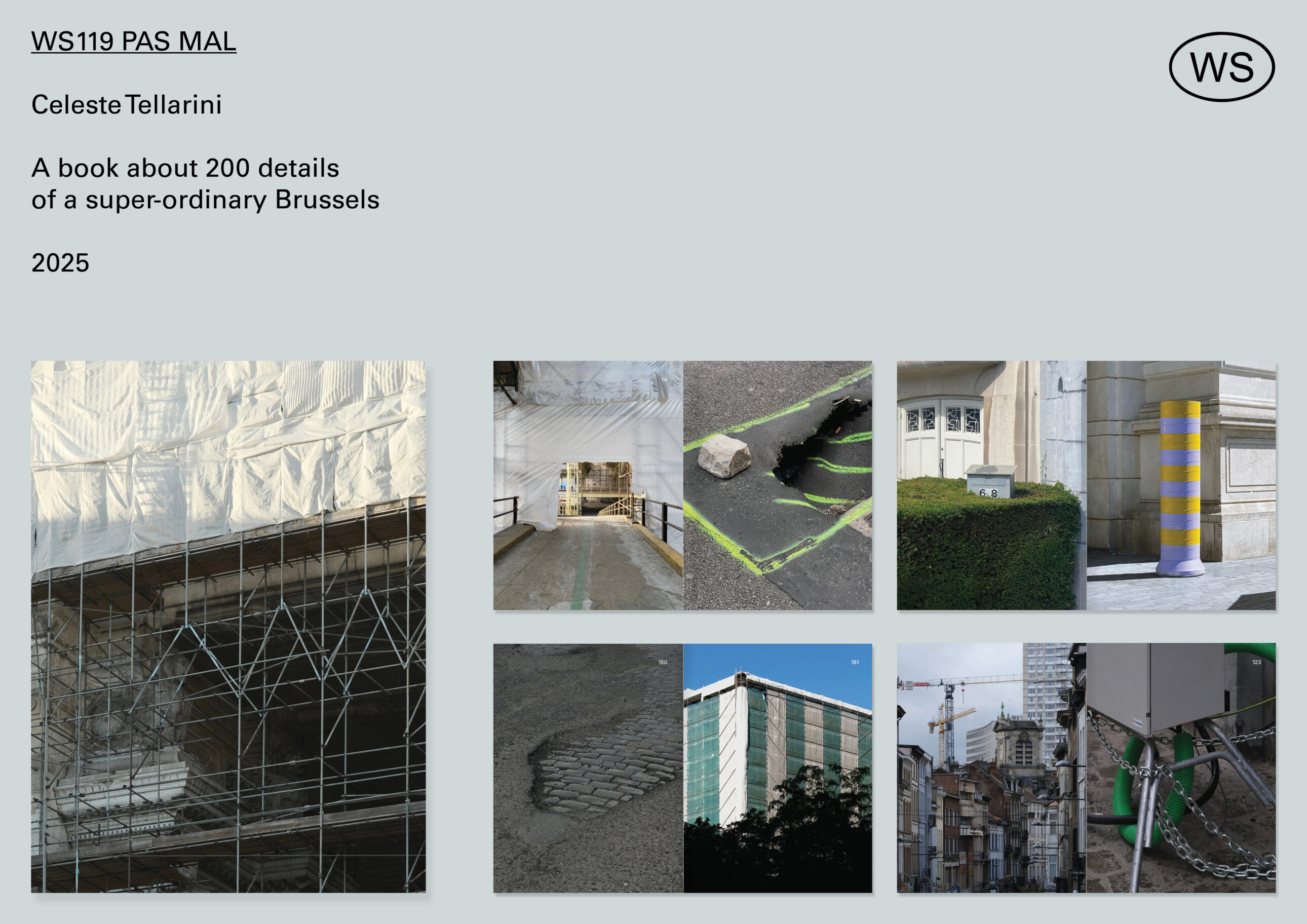
We all know that, for many years now, photography has no longer sought to represent an extraordinary vision, favouring instead a more prosaic gaze and a fascination with the everyday. This tendency is often associated with an aesthetics of the banal and a form of representation devoid of affectus.
Celeste Tellarini does not necessarily subscribe to this discourse. On the contrary, she can only look at what surrounds her through a resolutely romantic gaze. In this way, every aspect of daily life becomes worthy of attention and reveals an infinity of astonishing elements, omnipresent around us.
PAS MAL was born out of a spontaneous fascination with the city of Brussels, with what often goes unnoticed there, as well as an unquestioned attachment to places and people. The series focuses on framing situations rather than objects, and on observing scenes rather than isolated elements.
It is a process of reappraising the ordinary: beige places, neglected corners, and unplanned inventions of everyday life. Through unexpected contrasts and quiet coexistences, these images reveal a city that is never boring, never banal.
- - -
Celeste Tellarini (IT, 1994) is an architect and photographer, based in Brussels.
Walkscapes is a Brussels-based publishing platform, founded in 2016 by Gianni Villa (FR, 1990) and Wanling Chang (TW, 1987). Walkscapes produces books, magazines and exhibitions dedicated to the slow exploration of contemporary territories through the practice of walking.
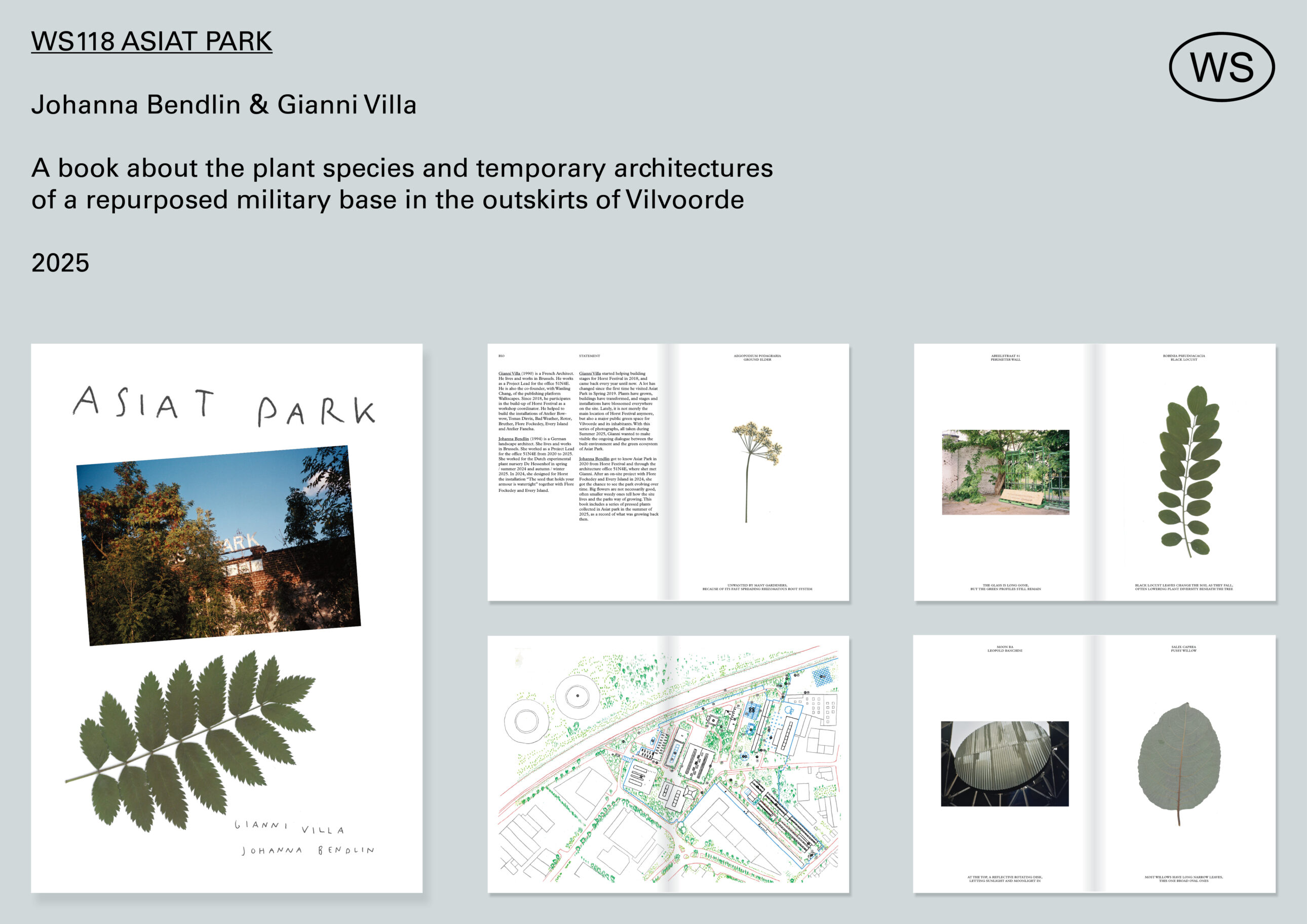
Gianni Villa began helping with the construction of stages at the Horst Festival in 2018 and has returned every year since. Much has changed since he first visited Asiat Park in the spring of 2019. Plants have grown, buildings have transformed, and stages and installations have blossomed across the site. In recent years, it has become not only the main venue for the Horst Festival, but also an important public green space for Vilvoorde and its residents. With this series of photographs, all taken during the summer of 2025, Gianni wanted to make visible the ongoing dialogue between the built environment and the plant ecosystem of Asiat Park.
Johanna Bendlin discovered Asiat Park in 2020 through the Horst Festival and the architecture firm 51N4E, where she met Gianni. After working on an on-site project with Flore Fockedey and Every Island in 2024, she had the opportunity to observe the park's evolution over time. The large flowers are not necessarily the most revealing; often it is the smaller ones, sometimes wild, that tell the story of how the site lives and the way the park develops. This book includes a series of pressed plants collected at Asiat Park during the summer of 2025, as a trace of what was growing there at that moment.
\- - -
Gianni Villa (1990) is a French architect. He lives and works in Brussels and works as Project Lead at the architecture firm 51N4E. He is also the co-founder, together with Wanling Chang, of the publishing platform Walkscapes. Since 2018, he has participated in the staging of the Horst Festival as a workshop coordinator. He has contributed to the construction of installations designed by Atelier Bow-Wow, Tomas Dirrix, Bad Weather, Rotor, Bruther, Flore Fockedey, Every Island and Atelier Fanelsa.
Johanna Bendlin (1994) is a German landscape architect. She lives and works in Brussels. She worked as Project Lead at the firm 51N4E from 2020 to 2025. She worked for the Dutch experimental nursery De Hessenhof in spring/summer 2024 and autumn/winter 2025. In 2024, she designed for Horst the installation *The Seed That Holds Your Armour Is Watertight* with Flore Fockedey and Every Island.
Walkscapes is a Brussels-based publishing platform, founded in 2016 by Gianni Villa (FR, 1990) and Wanling Chang (TW, 1987). Walkscapes produces books, magazines and exhibitions dedicated to the slow exploration of contemporary territories through the practice of walking.
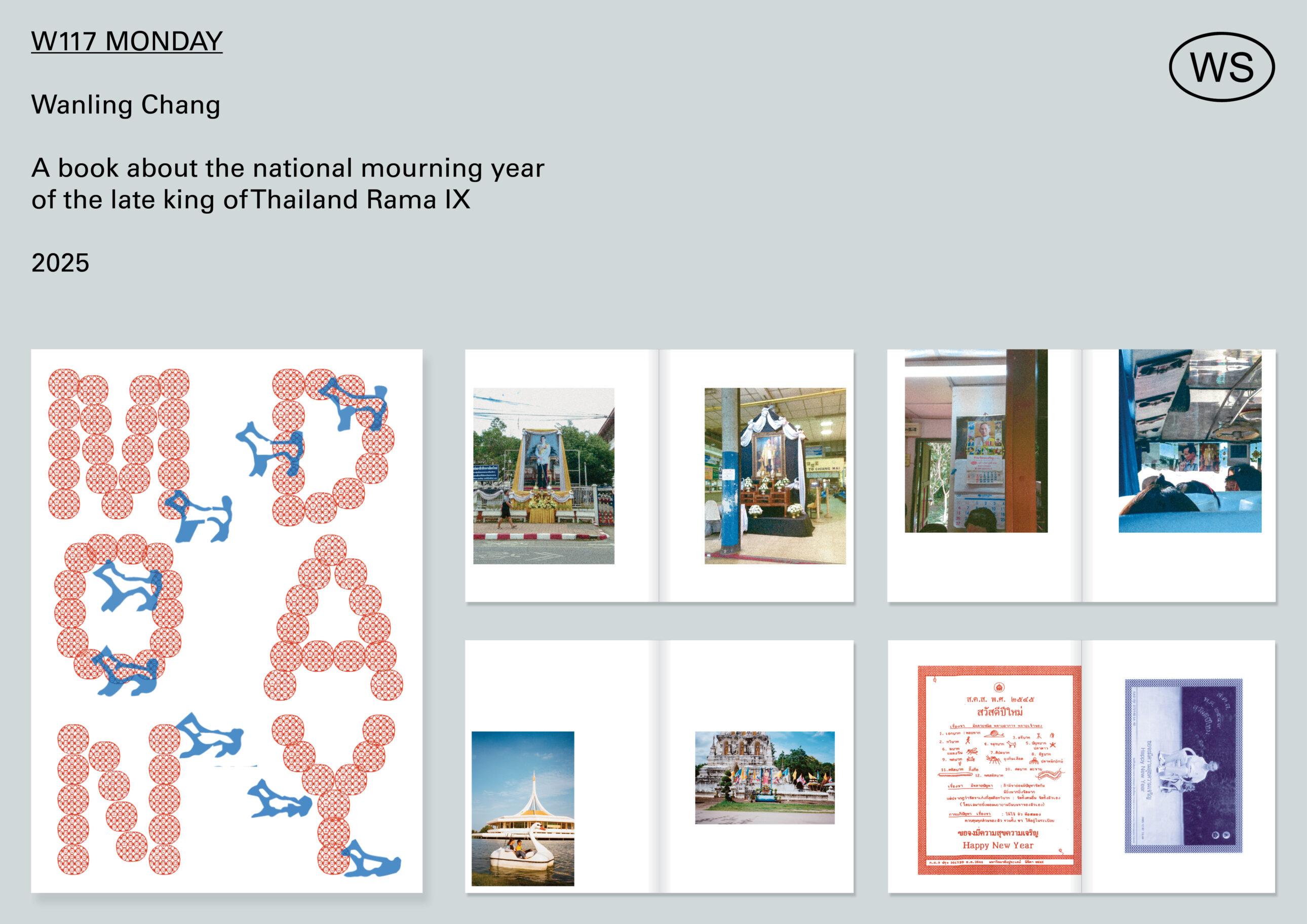
In 2016, His Majesty King Bhumibol Adulyadej (Rama IX) passed away on 13 October at the age of 88, after a reign of 70 years. He was the third-longest-reigning sovereign in history. The year following his death was decreed a period of national mourning. The royal cremation ceremony did not take place until the end of October 2017.
In the summer of 2017, I travelled to Thailand with my partner. Upon our arrival at the airport, memorials to the late king immediately reminded us that the country was still in a period of national mourning. These memorials—not only of the late king, but also of King Rama X and the late Queen Sirikit—could be seen everywhere: in front of schools, train stations, and beside temples. They all followed a general visual guideline, yet none were exactly the same. The widespread presence of these memorials caught my attention.
I had learned from the media about the Thai people’s deep kinship with their king, and I remembered seeing images of thousands of people gathered in front of the palace on the day of his passing. I then began to collect images of these memorials, without a clearly defined intention. The colour codes, the draped black, white, and purple cloth, the flowers, and the ornamental frames surround the portraits of the three core royal figures. A feeling of déjà vu recalled memories from my childhood in Taiwan in the late 1980s and early 1990s, when the country had just been liberated from martial law.
This book brings together different elements and archives collected during the 2017 trip. It also questions the gaze of a foreigner or tourist visiting a popular destination such as Thailand: how can one represent observation while holding back speculation and innocent assumptions? I chose to keep a certain distance between the subject and the object, dispersing the focus by intertwining it with intimate memories. Through this process, the memorials become both records of a public ritual and mirrors of personal memory, where distance allows reflection rather than explanation.
You are currently viewing a placeholder content from Facebook. To access the actual content, click the button below. Please note that doing so will share data with third-party providers.
More InformationYou need to load content from reCAPTCHA to submit the form. Please note that doing so will share data with third-party providers.
More InformationYou are currently viewing a placeholder content from Instagram. To access the actual content, click the button below. Please note that doing so will share data with third-party providers.
More InformationYou are currently viewing a placeholder content from X. To access the actual content, click the button below. Please note that doing so will share data with third-party providers.
More Information